Songs that Defeated Time: A Secret Recording of Resistance from 1941
A unique sound document of a concert by the Academic Choir during the Italian occupation of Ljubljana in 1941 has survived thanks to a microphone hidden in a chandelier in Ljubljana’s Union Hall. More than eighty years later, the restored recording is once again available to the public on the digital album The Songs That Defeated Time, released by ZKP RTV Slovenija in cooperation with Radio Slovenia – Program Ars
“Everything that happened at that time, all of the occupation, all of the events, all of the horror – all of it is on this tape! I was outside, in front of the hall. You really can’t imagine it. I thought it would literally burst the hall! Guys were standing on the windows, holding on to the handles so they wouldn’t fall down. You know, such moments are historic moments that you simply can’t reproduce. It’s impossible. You can’t translate that feeling. You have to experience it! People were crying because they knew they’d lost their homeland. They were crying because of the occupation.” [1]
Occupied Ljubljana, 12 December 1941.
The Second World War is raging.
The capital of Slovenia is Italianised, annexed to the Kingdom of Italy.
The Slovenian people are destined for destruction.
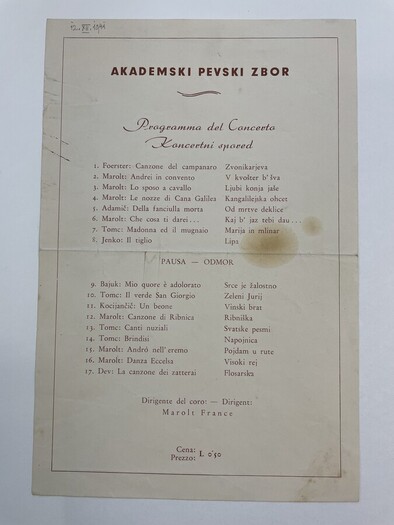
On stage in Ljubljana’s Union Hall, the Academic Choir conducted by France Marolt is singing. The concert programme consists entirely of Slovenian songs.
As composer Marijan Lipovšek later wrote in his role as a music critic: “In terms of content, the choral works encompassed everything that a simple folk song can offer: religious, narrative, love, occasional, wedding and dance works. They were the best of the best, and they all had a strong effect, either due to their exemplary choral style or their content. Thus, the quiet and collected mood was unattainably depicted by Zvonikarjeva (The Bell-Ringer’s Daughter), Lipa (The Linden Tree) and Srce je žalostno (The Heart Is Sad). Exuberance breathed from ... the witty Kaj b’ jaz tebi dau (What Could I Give You) ... and the silent yet great joy of the young people radiated from the beautiful Svatske pesmi (Wedding Songs) with their heartfelt Bela krajina melodies …” [2] The concert programme included seventeen songs, comprising artistic songs, nationalised songs and arrangements of folk songs by conductor and ethnologist France Marolt, as well as by Anton Foerster, Emil Adamič, Matija Tomac, Davorin Jenko, Marko Bajuk, Josip Kocijančič and Oskar Dev. Times were tough. Many of the singers in the Academic Choir wondered if they would ever sing again, or if they would even survive. Every last person in the hall recognised their fate in the programme and could identify with the verses of the opening song, Foerster’s Zvonikarjeva (The Bell-Ringer’s Daughter, melody and lyrics by Blaž Potočnik):
“Ring, ring, awaken for work,
as our life is but one day long ...”
or Bajuk’s composition Srce je žalostno (The Heart Is Sad, arrangement of a folk song from Drašiči):
“The heart is sad,
deeply wounded,
deeply wounded,
it could die ....”
Jenko’s setting of Vilhar’s text Lipa zelenela je (The Linden Green) was also included in the story of fate. Its ecstatic singing and lyrics told us:
“... a new green spring, a new flower will sprout.
Again the birds, the joyous birds,
will sing us songs...”
The song held the promise of rebellion.
Before the concert, the Italian occupation authorities demanded to see a detailed programme as well as the song lyrics in both Slovenian and Italian. [3] Nothing controversial was found in either the programme or the song lyrics, so they approved the concert. As Lev Svetek later recalled, “it was well known that the historic concert of the Academic Choir was organised in close cooperation with the Liberation Front as a dramatic cry of resistance against the occupier and everything he was planning…”. [4] In the days leading up to the concert, the singers rehearsed feverishly. They also used the time to distribute and sell tickets, which went quickly and, according to prior agreement, only into the hands of Slovenians. Every performance by the Academic Choir was highly anticipated, as it was considered the best Slovenian male choir and its concerts were a genuine “festival” for concert-goers.
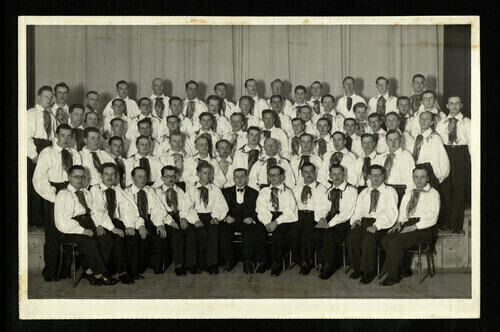
The pre-war Academic Choir with France Marolt (source: National and University Library (NUK), Music Collection, Academic Choir 1926–1941, Chronicle)
Microphone Hidden in a Chandelier
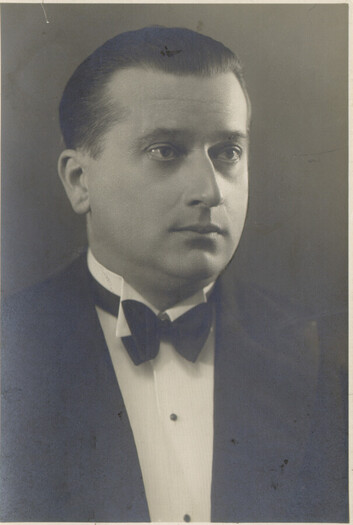
The singing was preserved in sound thanks to the ingenuity and skill of the sound engineer Rudi Omota and the presence of mind of Milan Kham, the director of the Union Cinema. A microphone was hidden in the chandelier closest to the stage. Before the concert, the chandelier was lowered, ostensibly for cleaning. In fact, the microphone was attached between the milky glass lights. Rudi Omota recalled the concert and the recording as follows: “Although the Italian occupation authorities had given permission for the concert, we knew that everything would be heavily guarded and that many other security measures would be taken. I should mention that Marolt’s Academic Choir was a politically progressive choir, and that most of the singers were close associates of the Liberation Front. By the choir – as well as by the director of the Union Cinema, Milan Kham, who was also closely connected to the Liberation Front – I was given the task of making a sound recording of the concert, which we all knew would be the choir’s last performance, on film stock. Unfortunately, there was not enough film stock available. We had barely 300 meters, which would be enough for only 10 minutes of recording. However, since the sound track on the film stock is only a few millimetres wide, and the film stock itself is 35 millimetres wide, the majority of the emulsion surface is unused. I made a quick decision and constructed a cutting device that cut the film stock in half lengthwise. In this way, I gained another 300 meters, so I had enough for 20 minutes of recording in total. The work that followed was carried out in complete secrecy. Only a few of the most reliable people knew about it. I don’t remember exactly when, at what time, I installed the single microphone. It had to be completely invisible to the eye. Whether it was the night before the concert or the morning of the concert, I can’t remember anymore. I was satisfied that I had done the job. I lowered the microphone on a wire from the ceiling to the chandelier, where it was safely hidden. On the evening of the concert, I sat in a room behind the projection screen – locked, of course – and made the recording. Even though I wasn’t physically present in the hall, I could sense from the recording how the audience was getting involved. They followed the performance of Marolt’s singers enthusiastically, yet at times in deathly silence. During the performance of Jenko’s Lipa, the audience sobbed. On the recording you can clearly hear the resounding sadness that was the bitter companion of those times, speaking of struggle and death. This event shook me to the core as well. After I had processed the audio tape, I played it to Marolt and the singers, in the presence of his most loyal collaborators. Then I stored it away.” [5] Jenko’s Lipa (Linden) was the last song in the first half of the concert. From the choir’s singing and the response of the audience, it became clear to the Italian soldiers that it was more than just a song about a tree: the beginning of the song about a blooming linden tree in summer was sung in an exuberant manner, appropriate for summer; the continuation about a linden tree in winter, which loses its leaves and almost withers, was sung in a slow, flowing pianissimo; and the conclusion of the song, which announces the renewal of the linden tree in spring, was sung loudly, resolutely and with irrepressible enthusiasm. During the intermission, the Italian soldiers began to run around and consult with one another. Finally, they demanded that the concert be stopped. But it was too late: the occupation authorities had already approved the concert. It never occurred to the censors that the interpretation of a song could also constitute a rebellion. As well as being a master of his profession, France Marolt was also a master of interpretation. That is why the recording of the concert is not just a record of a musical moment, but a prophecy of the Slovenian nation, the essence of which the conductor and choir gave voice to at the climax of the concert, in Lipa. Composer Vilko Ukmar was also among the audience: “Marolt was ingenuous: never predictable, never the same Marolt. Consequently, the choir followed him relentlessly, because they had to know... at every moment the singers had to be ready for something to change, ready to follow Marolt. This concentrated the forces of the choir into a single point, into the conductor’s fantasy, which led the declaration straight to the end with such force that an explosion was inevitable. It was so spontaneous, so ambitious, so ingenious, strong and violent that at the end the hall shook as if the whole thing was about to collapse.” [6] The Academic Choir was disbanded immediately after the concert. [7] Eight of its members – an octet led by Boris Trampuž – continued to secretly rehearse and record for Radio Kričač. [8] The recording and the performance are so charged with emotion that they still bring tears to the eyes today. It is a timeless moment. Marolt’s interpretative framework is still valid. It has become a symbol of defiance and resistance to the occupier for all time: for yesterday, today and tomorrow. The recordings of the other performances of arrangements of Slovenian folk songs is also a testament to Slovenian patriotism and defiance. This is embodied by the interpretation of the Academic Choir and, not least, by France Marolt’s choice of programme. The inclusion of Slovenian songs, especially folk songs, was not incidental; it was the result of careful consideration and preparations for the concert in occupied Ljubljana.
A Recording That Survived the Test of Time
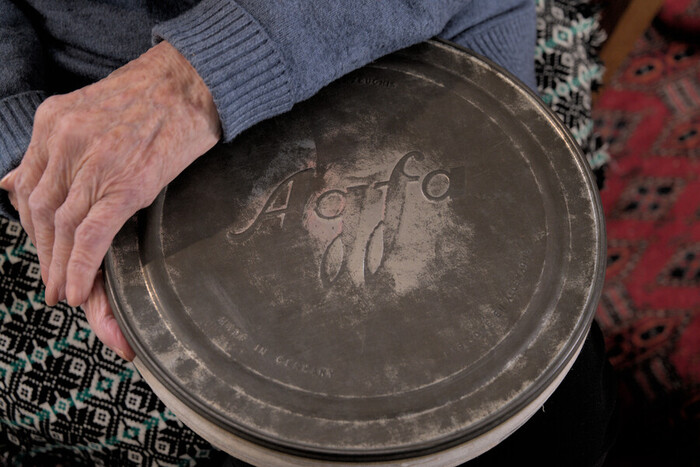
Emilija Soklič explains how technical innovator and a sound engineer Rudi Omota, a pioneer of Slovenian sound film, felt about the recording: “You know – if he gave it to me… he was afraid that something would happen to it. He said: ‘You will take the best care of it.’ You know how many years we worked together professionally. Many years. He was convinced that I would take care of it best, so that it would end up in the right hands. He entrusted it to me. It was sacred to him, just as it is to me. I’m glad that you know how to respect it and I’m sure you’ll take good care of it. Rudi left it to me as his greatest legacy. I’m thrilled that you’re doing this.” [9] On the initiative of Andrej Pitako, engineer and innovator Emilija Soklič, a pioneer of sound recordings for Slovenian film, decided to donate the priceless recording to the Ars Channel of Radio Slovenia. It was nonetheless difficult for her to part with the tape. Tears rolled down her cheeks from her sparkling eyes. On making her donation, she entrusted the recipient with the task of treating the gift with respect and with the greatest possible awareness of its significance. That is why we are returning the tape to the homeland and its people. The recording of Jenko’s Lipa on this tape is not a song about a tree; it is a song about the homeland and its people, it is a song about longing, a song about freedom in the midst of war. On 21 April, we organised a concert in Ljubljana’s Union Hall – the scene of the historical event – and released a compact disc. In doing so, we recalled a monumental event of national importance and reminded ourselves that there are still people in the world who are forbidden to sing in their native language. The state of Slovenia is 35 years old. At its birth, we chose the Slovenian anthem. The song Lipa zelenela je (The Linden Green) was on the shortlist. Although it was not selected, the fact that it made the shortlist is telling enough.
Brigita Rovšek
Music Editor
Today and Tomorrow
The journey of the donated tape, recorded by Rudi Omota in 1941, was led by Ingrid Kovač Brus, editor-in-chief of the Ars Channel of Radio Slovenia, who approached the project with the utmost awareness of the fragility and pricelessness of the recording. She was joined by the head of the RTV Slovenia Mediatheque, Bojan Kosi, and the head of the Classical Music Department of the Ars Channel, Gregor Pirš. Their task was facilitated by numerous meetings and conversations with experts in film directing and friends of Rudi Omota and Emilija Soklič: Borko Radešček, Dušan Sever, Rado Likon and Amir Muratović. Further assistance was provided by staff of Radio Slovenia: music producer Matjaž Prah, sound engineer Miro Prljača and the head of music production Dr Žiga Stanič. The recording of the Academic Choir concert from 12 December 1941, made with a microphone secretly hidden in a chandelier of the Union Hall in Ljubljana, is unique in the world, which is why we have initiated the procedures for its inclusion on the UNESCO List of Intangible Cultural Heritage. Below we describe the journey of the original tape from the moment it passed from the hands of Emilija Soklič into the ownership of the Ars Channel of Radio Slovenia, recounting events with a subtle sense of intertwining the technical and the artistic.
Technical Description of the Tape’s Condition and the Restoration Procedures
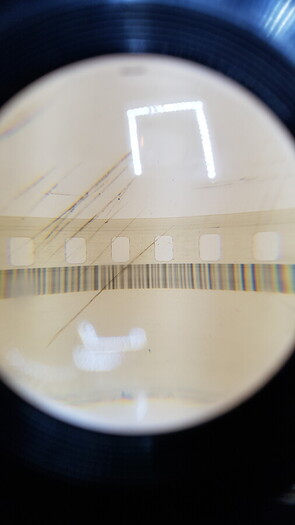
The recording of the Academic Choir from 1941 is preserved in the form of an optical record on 17.5 mm nitrate film stock, which has been stored in a metal box since its creation. The tape is wound into two 290 metre-long rolls, originally created from a single 35 mm roll of film stock. The recording device, which was designed and constructed by Rudi Omota himself before the war, recorded the sound on a narrow strip near the edge of the film stock. The 35 mm film stock was cut lengthwise into two parts before recording, thus doubling its length. This enabled him to record 20 minutes of the concert. Rudi Omota made the device for reproducing the sound from the optical record on the film stock himself. After the Second World War, the recording from the optical record was copied onto other sound media several times. One of these transcriptions was made on a ¼ inch magnetic tape that is held by the Radio Slovenia Recording Archive. The tape documentation is dated 25 November 1962/Studio 11, which means that the recording was transcribed at that time onto the magnetic tape that is kept in the archive. The tape was subsequently digitised on 25 March 2009 as part of a radio archive digitisation project. Unfortunately, the recording on the tape is flawed, as the recording speed is too fast. This was determined by comparing it with the last transcription made by Rudi Omota. The last known transcription from the original 17.5 mm film tape was made by Rudi Omota and Dušan Sever in the 1990s (1994 or 1995) at the VIBA Film studio. The reproduction was made using a device constructed earlier by Rudi Omota for recording and reproducing sound from 17.5 mm magnetic film stock (so-called ‘perfo tape’ or SEPMAG). For the purpose of the transcription, the device was modified so that it could reproduce sound from the optical recording (the magnetic head was replaced with an optical head, the playback speed was corrected and the frequency equaliser was set). After completing the transcription, they remodified the device to play sound from magnetic perfo tapes. Rudi Omota brought all the additional parts required for the reconstruction of the device with him and took them away after the transcription was completed. The recording was transcribed onto Scotch ¼ inch magnetic tape, using a Studer tape recorder. Rudi Omota then further processed the transcription on ¼ inch magnetic tape by filtering. He made several copies of the final recording on audio cassettes, which he later donated on various occasions. There also exist copies of the recording on compact disc, which were made from the ¼ inch magnetic tape by Rudi Omota and Borko Radešček in 2000. These CD transcriptions were made at Borko Radešček’s home. Rudi Omota brought the magnetic tape with him and then took it away again afterwards. After that, all traces of the ¼ inch magnetic tape were lost. The additional components that were used to modify the playback equipment at the VIBA Film studio to make the transcription from the original tape were also lost. The original film stock with the optical sound recording of the concert has, however, been preserved. Prior to his death, Rudi Omota handed the film stock over to his long-time colleague Emilija Soklič for safekeeping, and she donated it to the Ars Channel of Radio Slovenia in 2023. RTV Slovenia has been granted a permit by the Ministry of Culture of the Republic of Slovenia to manage its own storage of archival material. The material protection of audio and audiovisual material is carried out at the RTV Slovenia Mediatheque, where Rudi Omota’s original recording is also stored. Due to the analogue transcription, analogue processing (filtering) and multiple analogue copying, it is possible that all of the available copies of the recording at our disposal differ significantly from the original recording, as pointed out by a panel of experts who listened to the recordings in 2023. Furthermore, it would be difficult to determine which of the available copies is the best. At RTV Slovenia, we therefore decided to undertake a re-transcription and professional restoration of the recording from the original film stock. RTV Slovenia does not possess the required technical equipment for the physical restoration and digitisation of sound from an optical recording on 17.5 mm nitrate film stock, nor are there suitable technical facilities for this process anywhere else in Slovenia. We therefore sought assistance from the L’Immagine Ritrovata laboratory in Bologna, where the physical restoration and digitisation of sound from the film stock was carried out. RTV Slovenia organised the delivery of the material to the L’Immagine Ritrovata laboratory in Bologna on 15 April 2025. The laboratory performed an expert examination of the tape, undertook minor restoration work, ultrasonically cleaned it and transcribed the sound from the tape with a specially adapted optical device for reading optical sound recordings and converting them into audio recordings. The digitised audio recording in PCM 96kHz/32Bit-Float format was received from the L’Immagine Ritrovata laboratory electronically on 14 May 2025. We then arranged the return of the archive material from Bologna on 5 August 2025 and safely stored it in the archive of the RTV Slovenia Mediatheque. The transport of the material was carried out on the basis of a general export permit for archive materials of RTV Slovenia, issued by the Ministry of Culture of the Republic of Slovenia. The digital restoration of the recording was carried out in-house in the studios of Radio Slovenia.
Bojan Kosi
Head of the RTV Slovenia Mediatheque
Restoration and Remastering of the Historical Recording
After the physical restoration and digitisation of the audio recording in the L’Immagine Ritrovata laboratory in Bologna, and further processing in Studio 15 of Radio Slovenia, we now have two versions of the concert recording in addition to the original unprocessed recording:
1. a version with basic noise and pop correction,
2. a restored recording with sound balancing.
The decision was made to keep the recording as authentic as possible, with corrections only where they did not interfere with the musical expressiveness or sonic quality of the performance. The main interventions were aimed at removing noise and short pops (1) and at discrete frequency, spatial and event-focused sound balancing.
Aesthetic and Professional Responsibility
The restoration of old sound recordings is not only a technical undertaking but also an aesthetic and cultural task. It is a matter of finding a balance between retaining fidelity to the historical recording and satisfying the demands of the contemporary listening experience, especially in terms of the colour, depth and spatiality of the sound. Due to the technological limitations at the time when the recordings were made, the task was extremely delicate. The aim was to preserve the vocal clarity and brilliance of the choral performance, which is difficult to replicate today. The technically demanding restoration procedures were carried out by sound engineer Miro Prljača, while music producer Matjaž Prah took responsibility for the vocal-aesthetic balance of the recording. Although the digitisation of the original was carried out abroad, it was the final restoration and remastering in Slovenia that returned the recording to its true expressiveness and warmth, as a tribute to Slovenian musical culture as well as to the time and place of the concert: in the middle of occupied Ljubljana during the Second World War.
Dr Žiga Stanič
Head of Music Production
Matjaž Prah
Music Producer
Translation: Neville Hall
Listen to the Release
The digital release The Songs That Defeated Time is available from ZKP RTV Slovenija:
The Songs That Defeated Time – ZKP RTV Slovenija
The Story Continues on the Ars Channel
The story of Omota’s tape continues on 1 October on the Ars Channel as part of the Ars listening sessions at the 40th Slovenian Music Days.
1 October, 13:05–14:00 – Razgledi in razmisleki + Naši operni umetniki
300 metrov upora – kronika filmskega traku Rudija Omote (300 Metres of Resistance – Chronicle of Rudi Omota’s Film Stock)
A discussion about the radio documentary with director Klemen Markovčič and guests Rado Likon, Dušan Sever, Brigita Rovšek and Bojan Kosi | Anamarija Štukelj Cusma
1 October, 22:05–23:00 – Radijska igra
300 metrov upora – kronika filmskega traku Rudija Omote (300 Metres of Resistance – Chronicle of Rudi Omota’s Film Stock)
Radio documentary | Klemen Markovčič
Notes
[1] Emilija Soklič in conversation with Brigita Rovšek, 9 February 2023, on the handover of Rudi Omota’s recording to the Ars Channel of Radio Slovenia.
[2] Marijan Lipovšek in the newspaper Jutro, 16 December 1941, year XX., no. 293, p. 4.
[3] Emil Cesar: Boj brez puške (A Battle Without Guns), Založba Borec, Ljubljana 1984, p. 115.
[4] Lev Svetek in the broadcast Srečanja s slovenskimi skladatelji – France Marolt v spominih (Encounter with a Slovenian Composer – In memory of France Marolt), Radio Slovenia, created by Janez Bitenc, 6 April 1981, LJ.GP109688.
[5] Rudi Omota in the broadcast Srečanja s slovenskimi skladatelji – France Marolt v spominih (Encounter with a Slovenian Composer – In memory of France Marolt), Radio Slovenia, created by Janez Bitenc, 6 April 1981, LJ.GP109688.
[6] Vilko Ukmar in the broadcast Na današnji dan (On This Day), Radio Slovenija, LJ.NDD43.08.
[7] Studia historica Slovenica, Časopis za humanistične in družboslovne študije (Journal of Humanities and Social Studies), Year 24 (2024), No. 1: Petra Grabrovec, Marjeta Pisk and Darko Friš: “Zazvenela je naša pesem”: delovanje predvojnega Akademskega pevskega zbora in pomen sklepnega koncerta v obdobju okupacije leta 1941 (“Our Song Resounded”: The Activities of the Pre-War Academic Choir and the Significance of the Final Concert During the Occupation in 1941), p. 124.
[8] Emil Cesar: Boj brez puške (A Battle Without Guns), Založba Borec, Ljubljana 1984, pp. 121–123.
[9] Emilija Soklič in conversation with Brigita Rovšek, 9 February 2023, on the handover of Rudi Omota’s recording to the Ars Channel of Radio Slovenia.